

Retirement is one of the biggest financial decisions you’ll ever make. It’s not just about reaching a certain age, getting tired of work, or seeing a large number on your investment statement. The real question is whether your money can support your lifestyle for the rest of your life, even when markets fall, inflation rises, taxes change, or health care costs surprise you.
In this article, you’ll learn how to tell whether you truly have enough to retire. We’ll look beyond the “magic number” and focus on the real signs of retirement readiness: your spending, income, withdrawal plan, taxes, health care costs, inflation protection, and overall risk strategy.
Key Point / Summary
Knowing whether you’ve got enough to retire isn’t about one perfect number. It’s about whether your income, savings, investments, expenses, and risk plan all work together.
A solid retirement plan should answer these questions:
- How much will you actually spend each month?
- What income can you count on?
- How much will need to come from investments?
- What happens if the market drops?
- How will inflation affect your lifestyle?
- Have you planned for taxes and health care?
- What happens if one spouse passes away first?
- Do you have enough flexibility if life changes?
You shouldn’t retire based on hope, guesses, or general rules of thumb. You should retire with a clear plan that’s been tested against real-life risks.
Call to action: Before you retire, schedule a personalized retirement readiness review. It can help you see whether your current plan supports the lifestyle you want — or whether you’ll need to make adjustments first.
So, how Do You Really Know if You’ve Got Enough to Retire?
1. You Know Your Real Retirement Spending Number

The first step is knowing what retirement will actually cost. Many people assume their expenses will automatically go down once they stop working. Sometimes they do, but in my experience I’ve found that’s often not the case.
You might spend less on commuting, work clothes, payroll taxes, and retirement plan contributions. But you’ll likely spend more on travel, hobbies, home projects, dining out, medical care, or helping family members.
That’s why you need a realistic retirement budget. Don’t rely on a guess like, “We’ll probably need around $6,000 a month.” Instead, review your bank statements, credit card bills, insurance premiums, property taxes, and regular expenses. If this task seems overwhelming, there is a company called Monarch Money that I have found to be very helpful. Monarch helps simplify your finances by bringing all your accounts together into one clear view so you can see what’s actually happening instead of guessing.
You’ll also want to separate your essential expenses from your lifestyle expenses. Essentials include housing, utilities, groceries, insurance, taxes, transportation, and health care. Lifestyle expenses include travel, entertainment, gifts, charitable giving, home upgrades, and hobbies.
A strong retirement plan also includes irregular expenses. You’ll probably need to replace a car, repair the roof, pay for dental work, help with a family event, or take a major trip at some point. If you haven’t planned for those costs, they can put pressure on your portfolio.
Call to action: A retirement income analysis can help turn your spending estimate into a clear monthly income target, so you’ll know what your savings actually need to produce.
- Pros of knowing your spending number:
- You’ll have a clear income goal
- You’re less likely to overspend early in retirement
- Your withdrawal plan will be more accurate
- You’ll feel more confident because you’ll know what your lifestyle costs
- Risks of guessing:
- You might retire too early
- You could withdraw too much
- You may underestimate taxes or health care
- You might have to cut back later
2. Your Guaranteed Income Covers Your Core Needs
One of the strongest signs that you’re ready to retire is having enough guaranteed income to cover your essential expenses. Guaranteed income might include Social Security, pensions, or certain annuity payments.
This matters because guaranteed income doesn’t depend directly on the stock market. If the market drops, your Social Security check still arrives. If you have a pension, that income may continue regardless of what your portfolio is doing.
To evaluate this, compare your essential monthly expenses with your guaranteed monthly income. For example, if your essential expenses are $5,000 per month and your Social Security and pension income total $4,500, your investments only need to cover the remaining $500 plus discretionary spending.
That’s very different from needing your investment accounts to cover nearly everything.
Social Security timing is also important. You can claim early, but your benefit will usually be permanently reduced. You can wait, and your benefit may increase, but you’ll need a plan to cover income before you claim. For married couples, this decision is even more important because survivor benefits can affect the spouse who lives longer.
Guaranteed income doesn’t mean you don’t need investments. It simply gives your retirement plan a stronger foundation. When your basic needs are covered, your portfolio can be used more flexibly for travel, legacy goals, inflation protection, and unexpected expenses.
Call to action: If you’re not sure when to claim Social Security or how to coordinate it with your investments, a retirement income review can help you compare your options before you make a permanent decision.
- Pros of strong guaranteed income:
- It provides stability during downturns
- It reduces pressure on your portfolio
- It helps cover your must-pay bills
- It can protect a surviving spouse
- Risks to review:
- Claiming Social Security too early
- Choosing the wrong pension option
- Assuming all income keeps up with inflation
- Ignoring taxes on retirement income
3. You’ve Got a Written Withdrawal Strategy

Having a large portfolio doesn’t automatically mean you’re ready to retire. What matters is how much you can safely withdraw, where the money will come from, and how your plan will adjust over time.
A withdrawal strategy tells you which accounts to use, when to use them, and how much to take. This is important because different accounts are taxed differently. Money in a traditional IRA or 401(k) may be taxed as ordinary income. Roth IRA withdrawals may be tax-free if rules are met. Taxable brokerage accounts may create capital gains.
If you withdraw from the wrong accounts at the wrong time, you could increase your taxes or reduce your future flexibility.
You’ll also need to protect yourself from sequence-of-returns risk. That’s the risk of experiencing poor market returns early in retirement while you’re also withdrawing money. If you’re forced to sell investments after a major downturn, your portfolio may have a harder time recovering.
A written withdrawal plan should explain what you’ll do in normal markets, strong markets, and bad markets. It might include cash reserves, income buckets, rebalancing rules, Roth conversion strategies, and guidelines for adjusting spending.
You shouldn’t rely only on a simple rule like “withdraw 4%.” That can be a starting point, but it’s not a complete retirement income plan. Your strategy should reflect your age, income sources, tax situation, investment allocation, risk tolerance, and goals.
Call to action: If your retirement income plan is still informal, now’s the time to build a written withdrawal strategy before you start depending on your savings for monthly income.
- Pros of a written withdrawal plan:
- You’ll know where income is coming from
- You can manage taxes more intentionally
- You’ll be less likely to panic during downturns
- You’ll have a process for adjusting withdrawals
- Risks of not having one:
- You might sell investments at the wrong time
- You could pay more tax than necessary
- You may drain accounts too quickly
- You won’t have a clear plan during a recession
4. Your Plan Has Been Stress-Tested
A retirement plan can look great when everything goes right. But real life doesn’t always cooperate. Markets fall. Inflation rises. Health care costs increase. Taxes change. A spouse may pass away. A family member may need help. A major home repair may come out of nowhere.
That’s why your retirement plan needs to be stress-tested.
Stress testing asks, “What happens if things don’t go according to plan?” What if you live to age 95 or 100? What if the market drops 25% in your first few years of retirement? What if inflation stays high? What if one spouse needs long-term care? What if one income source disappears?
The goal isn’t to predict the future perfectly. It’s to find weak spots before they become major problems.
If your plan only works under perfect conditions, it may not be strong enough. But if your plan can survive conservative assumptions, you’ll likely feel much more confident.
Stress testing may also show that small changes could make a big difference. You might decide to work one more year, reduce debt, delay Social Security, increase cash reserves, adjust investments, downsize, or reduce early retirement spending.
This is especially important if you’re retiring before Medicare, have most of your wealth in one stock or business, have a large age gap with your spouse, or want to leave money to family or charity.
Call to action: A professional retirement stress test can show how your plan performs under different market, inflation, tax, health care, and longevity scenarios.
- Pros of stress testing:
- It reveals risks before retirement
- It helps you make smarter trade-offs
- It shows how long your money may last
- It gives you more confidence in your decision
- Scenarios to test:
- A long retirement
- An early market downturn
- Higher inflation
- Higher health care costs
- Death of a spouse
- Major unexpected expenses
5. You’ve Planned for Taxes, Health Care, and Inflation
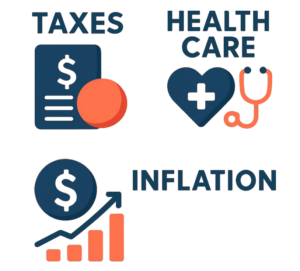
Many people focus on their investment balance but overlook three major retirement risks: taxes, health care, and inflation. These can quietly reduce your spending power over time.
Taxes matter because not all retirement dollars are equal. A dollar in a Roth IRA isn’t the same as a dollar in a traditional IRA. A pension, Social Security benefit, IRA withdrawal, annuity payment, or capital gain may all be taxed differently.
Without a tax strategy, you may pay more than necessary over your lifetime. You may also run into issues later when required minimum distributions begin.
Health care is another major concern. If you retire before age 65, you’ll need coverage before Medicare starts. Even after Medicare, you’ll still have premiums, deductibles, prescriptions, dental care, vision care, hearing care, and potential long-term care costs.
Medicare doesn’t cover everything. Long-term care can be one of the biggest threats to a retirement plan, especially if one spouse needs care for several years. Long term care is difficult to talk about because most people don’t really think they’ll ever need it. I must admit, I felt the same way until my mother had a massive stroke at 69-year-old. Life for my family changed that day.
Luckily, 15 years earlier, when I created the first financial plan of my career, for my parents, it included what the plan would be if long term care was ever needed. For them the plan was to buy LTC insurance. Which seemed unnecessary and just an added expense until it was actually needed. Without that plan life would be very different today.
Inflation is another risk you can’t ignore. Even moderate inflation can significantly reduce your purchasing power over a 20- or 30-year retirement. If your income doesn’t increase over time, you may feel comfortable early in retirement but squeezed later.
Your plan should show which income sources are inflation-adjusted and whether your investments have enough growth potential to keep up with rising costs.
Call to action: A professional retirement plan should include tax projections, health care assumptions, and inflation modeling — not just investment performance.
- Pros of planning for these risks:
- You’ll protect your purchasing power
- You may reduce lifetime taxes
- You’ll be better prepared for medical costs
- You’ll have a more realistic retirement picture
- Common mistakes:
- Treating all retirement accounts the same
- Forgetting about Medicare gaps
- Ignoring long-term care exposure
- Assuming expenses won’t rise
Conclusion
You really know you’ve got enough to retire when your plan can answer these important questions clearly. You know what your lifestyle costs. You know what income you can count on. You’ve got a written withdrawal strategy. You’ve tested your plan against difficult scenarios. You’ve accounted for taxes, health care, inflation, and longevity.
Retirement readiness isn’t just about your account balance. Two people can both have $1 million saved and be in completely different situations. One might have a pension, low expenses, no debt, and strong Social Security. The other might have high spending, large taxes, health care uncertainty, and no guaranteed income beyond Social Security.
The number matters, but the plan matters more.
The best retirement decisions are made before you’re forced to make them. If you’re within five to ten years of retirement, now’s the time to get specific. Build the income plan. Review the risks. Test your assumptions. Coordinate your accounts. Understand your taxes. Make sure your spouse or family understands the plan too.
Call to action: If you want to know whether you’re truly ready to retire, schedule a retirement readiness review consultation. A personalized review can help you see whether your current plan supports your ideal lifestyle — or what changes may help you retire with more confidence.
FAQs
How much money do I need to retire comfortably?
There’s no single number that works for everyone. The amount you’ll need depends on your spending, income sources, debt, health care needs, taxes, investments, life expectancy, and lifestyle goals. Instead of starting with a generic number, start with your expected annual expenses and compare them to your guaranteed income and portfolio withdrawal capacity.
Is the 4% rule still a good retirement guideline?
The 4% rule can be a helpful starting point, but it shouldn’t be your entire retirement plan. It doesn’t fully account for taxes, market conditions, health care costs, Social Security timing, pensions, or your personal spending flexibility. A customized withdrawal strategy is usually much more useful.
What’s the biggest mistake people make before retiring?
One of the biggest mistakes is retiring without a written income plan. Many people know how much they’ve saved, but they don’t know exactly how they’ll turn those savings into reliable monthly income. Without a plan, market downturns, inflation, taxes, and unexpected expenses can create stress later.