
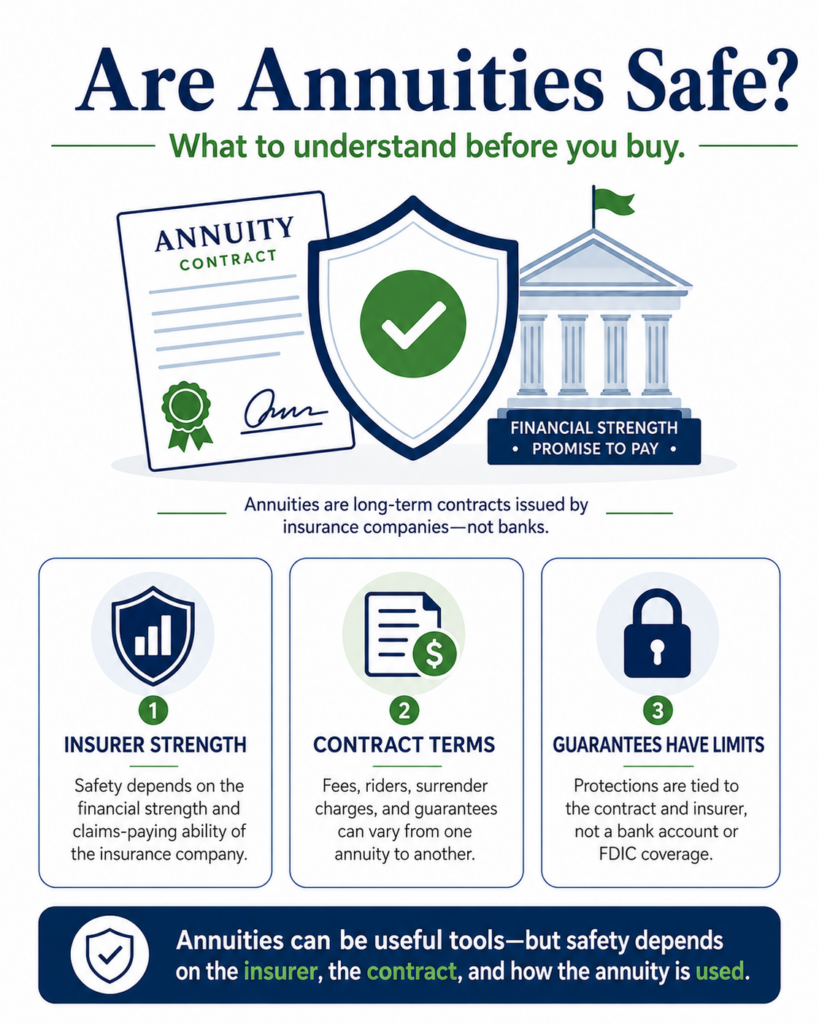
Are Annuities Safe? The Truth About Insurance Guarantees
Annuities are often sold with one powerful word: guaranteed.
That word can be comforting, especially if you’re nearing retirement and worried about market crashes, running out of money, or losing income when you no longer have a paycheck. But it can also create confusion because not all annuity guarantees work the same way, and not every guarantee solves the same retirement problem.
In this article, we’ll walk through five important things to understand about annuity safety and insurance guarantees. The goal isn’t to say annuities are good or bad. The goal is to help you understand what’s actually guaranteed, what isn’t guaranteed, who stands behind the guarantee, and how annuities should be evaluated inside a real retirement plan.
Short on time? Here is the Key Point / Summary
Annuities can be safe in certain ways, but their safety depends on the type of annuity, the contract guarantees, the financial strength of the insurance company, and whether the annuity fits your retirement plan.
Here are the five key things we’ll cover:
- Annuity guarantees are backed by the insurance company.
- Different annuities have different kinds of risk.
- Principal protection does not mean full flexibility.
- State guaranty associations may provide limited protection.
- The safest annuity is the one that solves the right problem in your plan.
An annuity is a contract between you and an insurance company where the company promises to make periodic payments either immediately or in the future. Insurance guarantees depend on the claims-paying ability of the issuing insurance company.
If you’re considering an annuity, the real question is not simply, “Is it safe?” The better question is, “Safe from what?”
Safe from market loss? Safe from running out of income? Safe from inflation? Safe from losing access to your money? Safe for your spouse? Safe for your heirs?
Those are different questions, and they may lead to different answers.
If you’re within a few years of retirement, a Retirement Readiness Review can help you test annuities against other income strategies before you buy a product, move money, or commit to a long-term contract.
Are Annuities Safe?
Annuities can be safe when they’re used properly, but they are not risk-free.
Some annuities are designed to protect principal. Some are designed to create lifetime income. Some are tied to investments and can fluctuate in value. Some offer income riders, death benefits, or index-linked crediting methods. Each type has different risks, benefits, costs, and limitations.
An annuity may protect you from one risk while exposing you to another.
For example:
- A fixed annuity may protect principal but limit upside.
- A fixed indexed annuity may protect against direct market loss but cap or limit growth.
- A variable annuity may offer investment upside but expose you to market risk.
- An immediate annuity may provide lifetime income but reduce liquidity.
- A deferred income annuity may create future income but may not help with near-term cash needs.
That’s why blanket statements like “annuities are safe” or “annuities are risky” are too simplistic.
The better approach is to ask what job the annuity is supposed to do and whether the trade-offs are worth it.
1. Annuity Guarantees Are Backed by the Insurance Company

The first thing to understand is that annuity guarantees are backed by the issuing insurance company.
That sounds obvious, but it’s important.
When an insurance company guarantees an annuity benefit, the guarantee is not the same as money sitting in a bank account. It’s a contractual promise from the insurance company. That means the strength of the guarantee depends heavily on the financial strength and claims-paying ability of that company.
That doesn’t mean insurance guarantees are weak. Strong insurance companies have been providing contractual guarantees for a long time. But it does mean you should know who is standing behind the promise.
Before buying an annuity, you should ask:
- Which insurance company is issuing the contract?
- What are the company’s financial strength ratings?
- How long has the company been in business?
- What exactly is guaranteed?
- What is not guaranteed?
- Is the income guaranteed or only projected?
- Is the account value guaranteed?
- Are rider benefits guaranteed?
- Can fees or caps change?
- What happens if the insurance company has financial trouble?
This is where people can get confused.
They may hear “guaranteed income” and assume everything about the annuity is guaranteed. That may not be true.
One part of the contract may be guaranteed, while another part is not.
For example, an annuity may guarantee a minimum income amount but not guarantee full liquidity. It may guarantee principal but not guarantee inflation protection. It may guarantee a death benefit but not guarantee strong growth. It may show projected values that are not guaranteed.
That’s why you need to separate:
- Guaranteed values
- Projected values
- Current rates
- Future renewal rates
- Rider benefits
- Death benefits
- Cash surrender value
- Income value
These are not always the same thing.
A Retirement Readiness Review can help you read an annuity proposal carefully and identify what is actually guaranteed.
- Annuity guarantees depend on the issuing insurance company.
- Financial strength matters.
- Not every number in an illustration is guaranteed.
- Income value, account value, and surrender value may be different.
- Always ask what is guaranteed and what is not.
2. Different Annuities Have Different Kinds of Risk

The second thing to understand is that not all annuities are built the same.
This is where the word “annuity” becomes too broad. Asking whether annuities are safe is like asking whether vehicles are safe. A pickup truck, sports car, minivan, and motorcycle are all vehicles, but they’re not the same tool.
Annuities work the same way.
A fixed annuity may offer a fixed interest rate for a certain period. It may be designed for principal protection and predictable growth. The trade-off may be limited upside and surrender charges.
A fixed indexed annuity may credit interest based partly on the performance of an index, subject to caps, spreads, participation rates, and other rules. It may protect against direct market losses, but your upside may be limited.
A variable annuity may allow you to invest in subaccounts. This can provide growth potential, but the account value may rise or fall depending on investment performance.
An immediate annuity may turn a lump sum into income right away. The income may last for life or for a set period, depending on contract terms.
A deferred income annuity may provide income later, often at a future age. This may help protect against longevity risk but may not offer much flexibility.
Each type of annuity answers a different question.
For example:
- Do you want principal protection?
- Do you want income now?
- Do you want income later?
- Do you want market-linked growth?
- Do you want lifetime income?
- Do you want death benefit protection?
- Do you want tax deferral?
- Do you want spouse protection?
The risk is buying the wrong annuity for the wrong job.
For example, if you need liquidity, an annuity with a long surrender period may not be safe for you. If you need inflation protection, a fixed income payment with no growth may not feel safe over 20 or 30 years. If you need guaranteed income, a market-based variable annuity without the right guarantee may not solve the problem.
A Retirement Readiness Review can help compare the different annuity types and determine whether any of them actually fit your retirement income needs.
- Different annuities have different risks.
- Fixed annuities may protect principal but limit upside.
- Indexed annuities may limit market losses but also limit gains.
- Variable annuities may expose you to investment risk.
- Income annuities may provide predictable income but reduce liquidity.
3. Principal Protection Does Not Mean Full Flexibility

The third thing to understand is that principal protection does not automatically mean full access to your money.
This is a big one.
Some annuities are promoted as protecting your money from market losses. That may be true under the terms of the contract. But protection from market loss does not mean there are no restrictions.
You may still face:
- Surrender charges
- Withdrawal limits
- Market value adjustments
- Rider fees
- Tax consequences
- Reduced benefits after excess withdrawals
- Limited access to lump sums
- Opportunity cost
- Inflation risk
This matters because retirement is unpredictable.
You may need money for healthcare, long-term care, home repairs, helping family, a vehicle, moving, travel, or emergencies. If too much of your savings is tied up in a contract, the annuity may feel safe on paper but restrictive in real life.
Surrender charges may apply when money is withdrawn during a surrender period, and those surrender periods can last six to ten years or sometimes longer.
That means you need to ask:
- How long is the surrender period?
- What is the surrender charge schedule?
- How much can I withdraw each year without penalty?
- Do withdrawals reduce income guarantees?
- What happens if I need more than the free withdrawal amount?
- Is there a market value adjustment?
- Can I access the full account value?
- What is the difference between account value and surrender value?
- What happens if I cancel the contract?
This is where some retirees get surprised.
They think, “My money is safe.”
But then they discover they cannot access all of it without penalties or consequences.
That doesn’t mean the annuity is bad. It means the money inside the annuity has a specific job. It may be designed for future income, principal protection, or lifetime cash flow. It may not be designed for emergency spending or flexible withdrawals.
That’s why you don’t want all of your retirement money doing the same job.
Some money may need to be liquid.
Some money may need to be invested for growth.
Some money may need to be protected.
Some money may need to create predictable income.
A good retirement income plan assigns jobs to dollars before buying products.
A Retirement Readiness Review can help determine how much money should remain liquid before considering an annuity.
- Principal protection does not always mean full liquidity.
- Surrender charges can limit access.
- Withdrawal limits may affect income guarantees.
- Emergency money should generally stay accessible.
- Safe on paper may not mean flexible in real life.
4. State Guaranty Associations May Provide Limited Protection

The fourth thing to understand is that state guaranty associations may provide limited protection if an insurance company becomes unable to meet its obligations.
This is important, but it’s also commonly misunderstood.
State guaranty associations are not a reason to ignore insurance company strength. They are a backstop, not the foundation of the decision.
State guaranty associations may provide protection in the unlikely event that a life, annuity, or health insurance company becomes financially unable to meet its obligations and is taken over by its insurance department.
Coverage limits vary by state.
Many states provide at least $250,000 in annuity contract value per owner, per insurer, but limits and rules can vary by jurisdiction. Some states may offer higher or different limits depending on the type of contract.
That means you should not assume unlimited protection.
Before buying an annuity, ask:
- What state guaranty association rules apply?
- What is the annuity coverage limit in my state?
- Is the coverage per owner, per insurer, or by another rule?
- Does it apply to this type of annuity?
- What happens if I own multiple contracts with the same insurer?
- Should I diversify among insurance companies?
- Am I relying too heavily on one company?
This is especially important for larger annuity purchases.
If you’re putting a significant amount of money into annuities, you may want to consider whether spreading contracts among multiple highly rated insurers makes sense. That may add complexity, but it can reduce concentration risk in some cases.
However, do not make this decision based only on guaranty association limits.
The better order is:
- Determine whether an annuity is needed.
- Decide what job the annuity should do.
- Choose the right type of annuity.
- Evaluate the insurance company.
- Understand state guaranty association limits.
- Decide how much money should go into the contract.
That’s a much stronger process than simply chasing the highest rate or biggest income quote.
A Retirement Readiness Review can help compare annuity options while considering company strength, contract terms, and concentration risk.
- State guaranty associations may offer limited protection.
- Coverage rules and limits vary by state.
- Guaranty protection is not unlimited.
- Insurance company strength still matters.
- Larger annuity purchases may require more careful diversification.
5. The Safest Annuity Is the One That Solves the Right Problem in Your Plan

The fifth and most important point is this: the safest annuity is the one that solves the right problem in your retirement plan.
An annuity is not automatically safe just because it has a guarantee.
It can still be the wrong fit.
For example, an annuity may be wrong if:
- You need liquidity.
- You already have enough guaranteed income.
- You don’t understand the contract.
- You’re putting too much money into one product.
- The surrender period is too long.
- The fees or trade-offs are unclear.
- The annuity creates tax problems.
- The surviving spouse is not protected.
- The product solves a problem you don’t have.
On the other hand, an annuity may be helpful if:
- You need more predictable income.
- Social Security and pensions do not cover essential expenses.
- You worry about outliving your money.
- You want to reduce pressure on investment withdrawals.
- You want a private-pension-like income stream.
- You want emotional stability during market downturns.
- You understand the trade-offs.
The key is to start with the retirement plan, not the product.
Before buying an annuity, you should know:
- How much income you need.
- Which expenses are essential.
- Which expenses are flexible.
- How much Social Security will provide.
- Whether you have pension income.
- How much your investments need to produce.
- What happens in a market downturn.
- What happens if one spouse dies.
- How much liquidity you need.
- What your tax situation looks like.
- Whether inflation protection is needed.
- What you want to leave to heirs.
Once those questions are answered, then you can evaluate whether an annuity helps.
The annuity should be compared against alternatives like:
- Investment withdrawals
- Treasury ladders
- CD ladders
- Bond ladders
- Delaying Social Security
- Pension survivor options
- Cash reserves
- Roth conversion strategies
- Reducing expenses
- Working part-time
The goal is not to be pro-annuity or anti-annuity.
The goal is to be pro-plan.
A Retirement Readiness Review can help test annuities alongside other retirement income strategies so you can see whether the guarantee is worth the trade-offs.
- An annuity should solve a specific retirement problem.
- Guarantees are valuable only if they match your needs.
- The wrong annuity can create false confidence.
- Always compare annuities against other strategies.
- The safest strategy is the one that works inside your full plan.
Conclusion
So, are annuities safe?
The honest answer is: they can be, but it depends.
Annuities can provide valuable guarantees, predictable income, principal protection, or lifetime cash flow. But those guarantees depend on the insurance company, the contract terms, and whether the annuity actually fits your retirement plan.
Annuities are not magic. They do not eliminate every risk. They often trade one risk for another.
They may reduce market risk but increase liquidity risk. They may provide lifetime income but reduce legacy value. They may protect principal but limit growth. They may feel safe emotionally but create restrictions you didn’t expect.
That’s why the word “safe” needs to be defined.
Safe from what?
If you want income you can’t outlive, certain annuities may help. If you want full access to your money, some annuities may not be a good fit. If you want growth, inflation protection, and legacy value, you may need investments too.
If you’re considering an annuity, a Retirement Readiness Review can help you test whether the product improves your plan or simply sounds safe in a sales presentation. We’ll compare income, taxes, liquidity, survivor protection, market risk, and alternatives so you can make a decision based on your actual numbers.
You don’t have to move your money. You don’t have to buy a product. You just need clarity before making a long-term commitment.
FAQs
Are annuities guaranteed?
Some annuity benefits may be guaranteed, but the guarantee depends on the type of annuity and the contract terms. Insurance guarantees are backed by the claims-paying ability of the issuing insurance company. Not every value shown in an illustration is guaranteed.
Can you lose money in an annuity?
It depends on the annuity. Some fixed annuities may protect principal under the contract terms. Variable annuities can lose value because they are tied to investment performance. Even with principal protection, surrender charges, fees, inflation, and withdrawal rules can still affect your outcome.
Are annuities protected if the insurance company fails?
State guaranty associations may provide limited protection if an insurance company becomes unable to meet its obligations, but limits and rules vary by state. This protection is not unlimited, so insurance company strength and contract diversification may matter.