

Annuities vs. Investment Withdrawals: Which Income Strategy Wins?
One of the biggest retirement income decisions you’ll face is how to turn your savings into a paycheck. For many retirees, the decision often comes down to two broad choices: use investment withdrawals or create predictable income with an annuity.
This can be confusing because both sides have strong opinions. Some people say annuities are the answer because they can create guaranteed income. Others say annuities are too restrictive and you’re better off keeping your money invested. The truth is, neither strategy automatically wins for everyone.
In this article, we’ll compare annuities and investment withdrawals in a practical way. You’ll learn how each strategy works, where each one may shine, where each one may fall short, and why the best retirement income strategy may actually use a combination of both.
Key Point / Summary
The annuity versus investment withdrawal decision is really a question of certainty versus flexibility.
Annuities can provide predictable income, sometimes for life, but they may come with less liquidity, complexity, fees, and trade-offs. Investment withdrawals can provide flexibility, growth potential, and control, but they also expose you to market risk, sequence-of-returns risk, and the possibility of outliving your money if withdrawals are not managed well.
Short on time? Here are the five key points we’ll cover:
- Investment withdrawals give you flexibility and growth potential.
- Annuities can create predictable income you cannot outlive.
- Market risk and longevity risk affect each strategy differently.
- Taxes, liquidity, fees, and legacy goals matter.
- The best strategy may be a blend, not an either-or decision.
The biggest mistake is choosing a strategy because someone says annuities or investments are always good or always bad. That’s not planning. That’s opinion.
A better approach is to test both strategies against your actual retirement income needs, savings, Social Security, pensions, taxes, risk tolerance, spouse protection, and long-term goals.
If you’re within a few years of retirement, a Retirement Readiness Review can help you compare income strategies before you commit to one path. You don’t have to move your money or buy a product. You simply need to understand the trade-offs before making a decision that could affect the next 20 or 30 years of your life.
Annuities vs. Investment Withdrawals: Which Income Strategy Wins?
The winning strategy depends on what you need your money to do.
If your biggest priority is flexibility, control, and growth potential, investment withdrawals may be more attractive. If your biggest priority is predictable income and reducing the fear of running out of money, an annuity may be worth considering.
But retirement income is rarely that simple.
Most people want several things at once:
- Enough income to pay the bills.
- Flexibility for travel and emergencies.
- Growth potential to fight inflation.
- Protection from bad markets.
- Confidence they won’t outlive their money.
- Something left for a spouse or heirs.
- A plan that feels comfortable emotionally.
That’s why the better question is not, “Which strategy wins?”
The better question is:
Which strategy, or combination of strategies, gives you the best chance of living the retirement you want without taking unnecessary risk?
1. Investment Withdrawals Give You Flexibility and Growth Potential
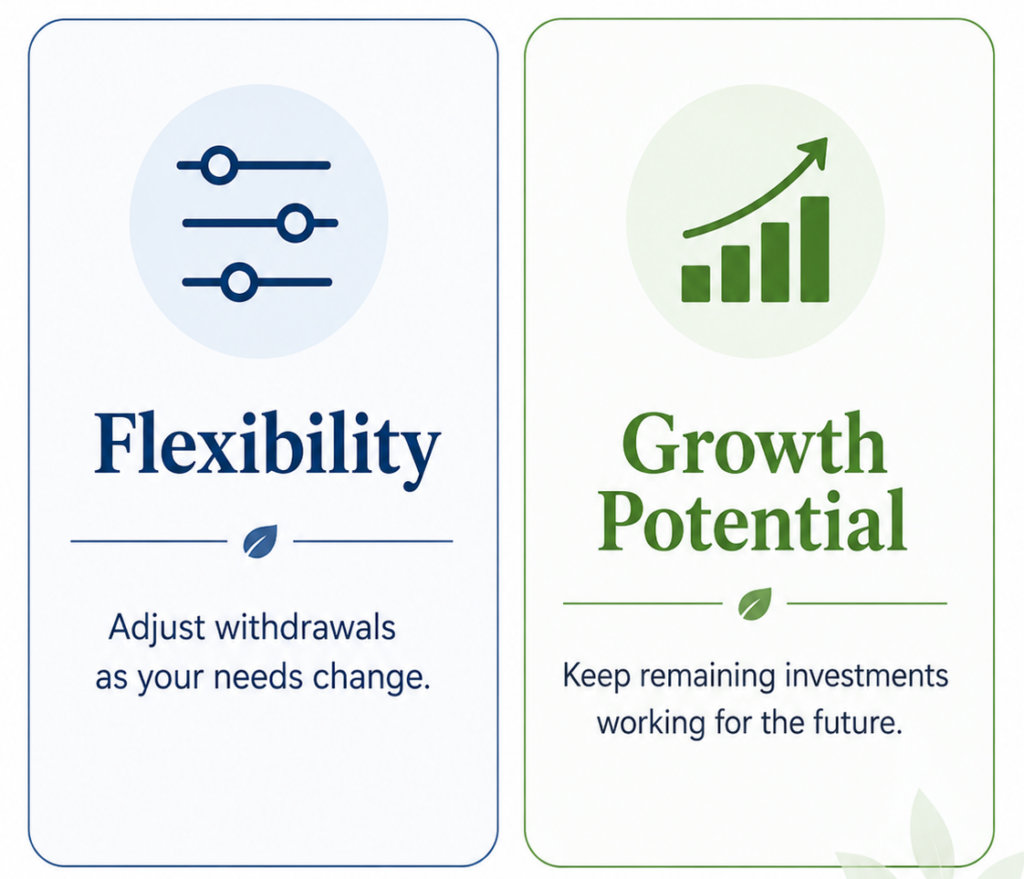
Investment withdrawals are probably the most familiar retirement income strategy.
This approach means you keep your money invested in accounts like IRAs, 401(k)s, Roth IRAs, or taxable brokerage accounts, and then withdraw money as needed to fund your retirement lifestyle.
What I’ve found after working with hundreds of retirees is, this approach seems to feel more natural. They spent decades building investment accounts, so continuing down the same path seems more familiar.
The biggest advantage of investment withdrawals during retirement is flexibility.
You can adjust withdrawals based on your needs. If you want to take a larger trip one year, you may be able to withdraw more. If markets are down, you may reduce spending temporarily. If your goals change, you can adjust the plan. If you want to leave money to children, charities, or other heirs, remaining assets may still be available.
That flexibility is valuable.
Investment withdrawals also provide growth potential. If your portfolio is invested well and markets perform reasonably over time, your money may continue growing throughout retirement. This can help fight inflation, support rising expenses, and preserve wealth.
That’s one reason many retirees prefer keeping a portion of their money invested. Retirement can last 20, 25, or even 30 years. Over that long of a period, inflation can sneakily reduce purchasing power. A portfolio with growth potential may help offset that risk.
But investment withdrawals come with real challenges.
The first challenge is market risk.
If markets fall, your account values may drop. That’s uncomfortable at any age, but it can feel much worse when you’re retired and taking income from the portfolio.
The second challenge is sequence-of-returns risk.
This is the risk that poor market returns early in retirement can do lasting damage because you’re withdrawing money while the portfolio is down. Even if the average return over time looks acceptable, bad returns in the wrong order can create problems.
The third challenge is behavioral risk.
Investment withdrawal strategies require discipline. When markets are strong, it can be tempting to spend too much. When markets are weak, it can be tempting to panic, sell investments, or abandon the plan.
A withdrawal strategy is only useful if you can stick with it.
This is why investment withdrawals should not be random. You need a system.
That system should answer:
- How much can you withdraw each year?
- Which accounts should you use first?
- How will taxes be handled?
- What happens if the market drops?
- How much should stay in cash?
- How often will the plan be reviewed?
- What spending can be adjusted if needed?
Investment withdrawals can work very well, but they require planning and ongoing management.
A Retirement Readiness Review can help test whether your investments can support your desired income under different market conditions.
- Investment withdrawals provide flexibility and control.
- They offer growth potential that may help fight inflation.
- They can support legacy goals if assets remain.
- They expose you to market and sequence-of-returns risk.
- They require discipline and regular monitoring.
2. Annuities Can Create Predictable Income You Can’t Outlive

Annuities are often misunderstood.
At their core, annuities are contracts with an insurance company. Depending on the type of annuity, they can be designed to provide income for a certain period, for your lifetime, or for the lifetimes of you and your spouse.
The biggest appeal is predictability.
An annuity can turn part of your savings into a stream of income. For retirees who worry about running out of money, that can be comforting.
This is especially valuable when you think about essential expenses.
If Social Security and pensions do not fully cover your basic bills, an annuity may help fill that gap with more predictable income. That can reduce the amount you need to withdraw from investments each month.
For example, suppose your essential expenses are $6,500 per month. Social Security provides $4,000 per month. That leaves a $2,500 monthly gap for basic expenses.
You could fund that gap through investment withdrawals. Or you could consider using an annuity to create part of that income. The right answer depends on your assets, health, goals, tax situation, and comfort with risk.
The benefit of annuity income is that it may not depend directly on stock market performance. If markets fall, the income from certain annuity contracts may continue according to the contract terms.
That can provide emotional relief.
Many retirees don’t just want the highest possible investment return. They want confidence that their basic lifestyle is protected and they can spend freely without needing to worry about running out of money.
Annuities can help with that.
But annuities also come with trade-offs.
The first trade-off is liquidity.
When you put money into certain annuity contracts, you may give up access to some or all of that lump sum. Some annuities have surrender charges, withdrawal limits, or limited flexibility. This can be a problem if you need money for emergencies, healthcare, family needs, or large purchases.
The second trade-off is complexity.
There are many types of annuities: immediate annuities, deferred income annuities, fixed annuities, fixed indexed annuities, and variable annuities. Each works differently. Each has different risks, fees, guarantees, and restrictions.
In order to keep this article reasonably short I won’t cover all the different types of annuities and their pros and cons, but I will have future articles that will go into great detail for each that will help you. If you don’t want to wait, check out the Retirement Readiness Review.
The third trade-off is inflation.
Some annuity income streams may not increase enough to keep up with rising costs unless inflation protection or cost-of-living features are included. Those features may reduce the starting income amount or change the economics of the contract.
The fourth trade-off is legacy.
Depending on the annuity type and payout option, there may be less money left for heirs. Some annuity options include survivor benefits or refund features, but those choices usually affect the income amount.
This is why annuities should not be bought casually.
They can be useful tools, but they need to be evaluated carefully.
A Retirement Readiness Review can help determine whether an annuity would solve a real problem in your retirement plan or whether investment withdrawals may be more appropriate.
- Annuities can provide predictable income.
- Some annuities can create lifetime income.
- They may reduce pressure on investments.
- They can help cover essential expenses.
- They may involve liquidity limits, complexity, fees, and legacy trade-offs.
3. Market Risk and Longevity Risk Affect Each Strategy Differently
The annuity versus investment withdrawal decision is really about which risks you want to keep and which risks you want to transfer.
Investment withdrawals leave more risk on your shoulders.
If markets perform well, you may benefit. Your portfolio may grow, your income may be sustainable, and you may have more money left later in retirement.
But if markets perform poorly, especially early in retirement, your plan may be pressured, which means you will be pressured
With investment withdrawals, you carry market risk.
You also carry longevity risk.
Longevity risk is the risk of living longer than expected and needing income for more years than planned. A long life is a blessing, but financially it can create pressure if your portfolio has to support withdrawals for 30 years or more.
Annuities can help transfer some longevity risk to an insurance company.
If you choose a lifetime income annuity, the income may continue for life, depending on the contract. That can reduce the fear of outliving that portion of your money.
This can be especially valuable for people who expect a long retirement, have longevity in their family, or worry about managing investments late in life.
But transferring risk usually comes with a cost.
When you use an annuity, you may give up some liquidity, upside potential, or legacy value in exchange for guaranteed income. That may be a perfectly reasonable trade-off, but it is still a trade-off.
There is no free lunch.
Investment withdrawals may win when markets are strong, inflation is manageable, and spending is flexible.
Annuities may win when predictability, lifetime income, and emotional confidence are more important.
The challenge is that you don’t know the future.
You don’t know what markets will do in your first five years of retirement. You don’t know exactly how long you’ll live. You don’t know whether inflation will be mild or painful. You don’t know what healthcare costs will look like.
That’s why retirement income planning should focus on resilience.
A resilient plan doesn’t depend on everything going perfectly.
For example, if you use only investment withdrawals, ask yourself:
- What happens if markets drop 25% early in retirement?
- Can I reduce spending temporarily?
- Do I have enough cash?
- Will I panic and sell?
- How long can the portfolio support income?
- What happens if I live to 95?
If you use an annuity, ask yourself:
- How much liquidity am I giving up?
- What happens if I need a large lump sum?
- Does the income keep up with inflation?
- What happens to my spouse?
- What happens if I die earlier than expected?
- What fees or surrender charges apply?
Neither strategy eliminates all risk. They simply handle risk differently.
The smartest retirement income plans usually recognize that different dollars can have different jobs.
Some dollars may be used for predictable income. Some dollars may stay invested for growth. Some dollars may remain in cash for emergencies. Some dollars may be reserved for legacy goals.
The question is not which strategy is perfect.
The question is which mix gives you the most confidence with the fewest unacceptable trade-offs.
- Investment withdrawals expose you to market risk.
- Annuities may help reduce longevity risk.
- Investment strategies may offer more upside potential.
- Annuities may offer more predictable income.
- The best choice depends on which risks concern you most.
4. Taxes, Liquidity, Fees, and Legacy Goals Matter
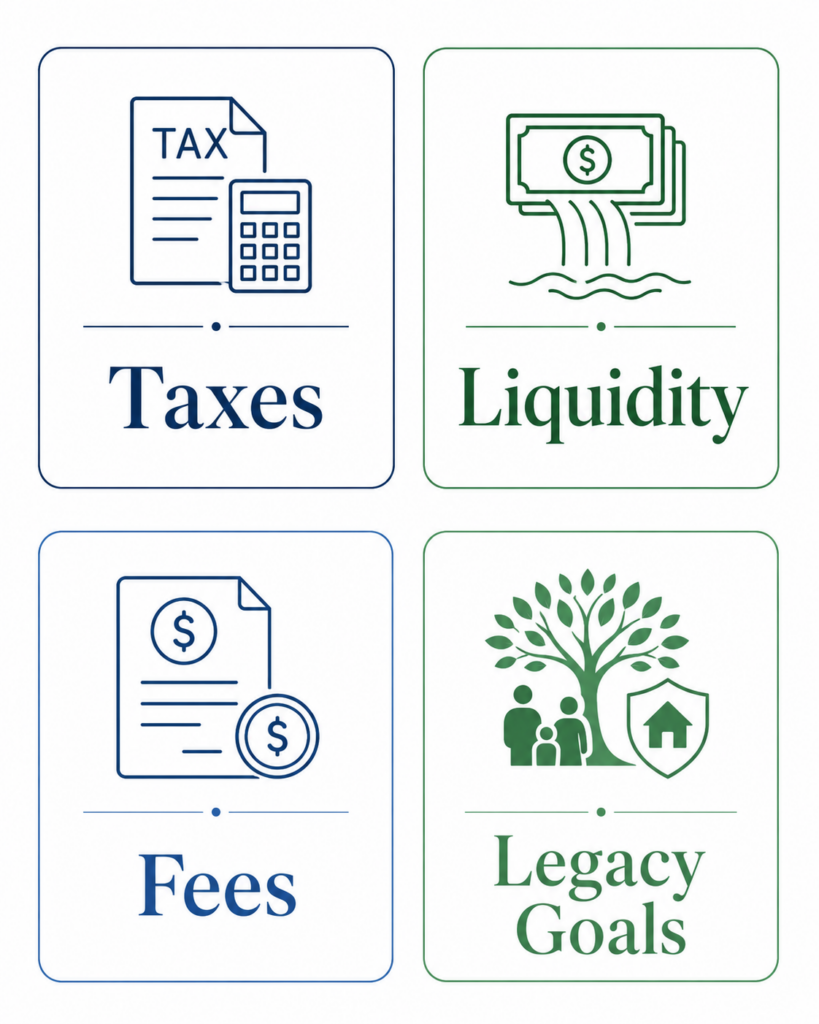
The income strategy that looks best on paper may not be best after taxes, fees, liquidity limits, and legacy goals are considered.
That’s why you need to look beyond the monthly income number.
Start with taxes.
Investment withdrawals and annuity income can be taxed differently depending on the type of account, the type of annuity, and how the money was funded.
For example, withdrawals from a traditional IRA or 401(k) are generally taxable as ordinary income. Roth IRA withdrawals may be tax-free if requirements are met. Taxable brokerage accounts may involve capital gains, dividends, or interest.
Annuity taxation depends on whether the annuity was purchased with qualified money, like IRA assets, or non-qualified money, like after-tax savings.
This matters because retirement is about after-tax income.
A strategy that produces $5,000 per month before taxes may not be as attractive if the after-tax result is much lower.
Next, consider liquidity.
Liquidity means access to your money.
Investment accounts are usually more liquid than annuities, although selling investments during a bad market can still be painful. Annuities may have surrender schedules, withdrawal limits, or penalties depending on the contract.
This matters because retirement is unpredictable.
You may need money for:
- Home repairs
- Medical expenses
- Long-term care
- Helping family
- Buying a vehicle
- Moving or downsizing
- Travel
- Emergency expenses
If too much of your money is locked into income contracts, you may feel financially trapped.
Then consider fees.
Both strategies can involve costs.
Investment portfolios may have advisory fees, fund expenses, transaction costs, or platform fees. Annuities may have insurance costs, rider fees, surrender charges, mortality and expense charges, administrative fees, or embedded costs depending on the product.
The point is not that fees are always bad. Sometimes a fee pays for something valuable. But you should understand what you’re paying, what you’re getting, and what alternatives exist.
Then consider legacy goals.
If leaving money to children, grandchildren, charities, or other heirs is important, the income strategy matters.
Investment accounts may leave remaining assets to heirs if they are not spent. Certain annuities may provide little or no remaining value after death depending on the payout option. Other annuities may include death benefits, refund features, or survivor options.
But again, those features usually affect the income amount or cost.
You should also think about spouse protection.
If you are married, the income strategy should not only work while both spouses are alive. It should also work after one spouse dies.
A single-life annuity may provide higher income while the annuitant is alive, but it may stop at death. A joint-life option may provide income for both spouses, but the monthly amount may be lower.
Investment withdrawals may provide more flexibility for a surviving spouse, but only if the assets remain and are managed well.
These are real trade-offs.
A retirement income plan should compare:
- After-tax income
- Access to money
- Fees and costs
- Spouse protection
- Inflation protection
- Legacy goals
- Risk tolerance
- Long-term flexibility
This is where blanket advice fails.
Saying “annuities are bad” ignores situations where guaranteed income may solve a real retirement problem. Saying “annuities are always the answer” ignores liquidity, fees, inflation, and legacy concerns.
Good planning sits in the middle.
It evaluates the tool based on the job it’s supposed to do.
- Taxes can change the real value of either strategy.
- Liquidity matters because retirement includes surprises.
- Fees should be understood, not ignored.
- Legacy goals may favor one strategy over another.
- Spouse protection should be built into the income decision.
5. The Best Strategy May Be a Blend, Not an Either-Or Decision

The biggest mistake in the annuity versus investment withdrawal debate is assuming you have to pick one side.
You may not.
For many retirees, the best answer may be a blended strategy.
That means using predictable income sources to cover essential expenses while keeping other assets invested for growth, flexibility, emergencies, and legacy goals.
Think of it this way.
Your retirement expenses are not all the same.
Some expenses are essential:
- Housing
- Groceries
- Utilities
- Insurance
- Healthcare
- Property taxes
- Transportation
Other expenses are more flexible:
- Travel
- Dining out
- Hobbies
- Home upgrades
- Gifts
- Entertainment
- Charitable giving
If your essential expenses are mostly covered by Social Security, pensions, and possibly annuity income, you may feel more secure. Then investment withdrawals can be used for flexible lifestyle spending, inflation protection, and long-term growth.
This can reduce emotional stress.
When markets drop, you may be less likely to panic if your basic bills are still covered. You may have the ability to reduce discretionary withdrawals temporarily without threatening your core lifestyle.
On the other hand, if all your income comes from investments, you may feel more exposed to market volatility.
That doesn’t mean all investment withdrawal strategies are bad. Many retirees do very well with a disciplined portfolio withdrawal plan. But the plan has to match the person.
Some people are comfortable with market volatility. Others are not.
Some people value control and liquidity above all else. Others value guaranteed income.
Some people want to leave a large legacy. Others want to maximize lifetime spending.
Some have pensions. Others don’t.
Some have more than enough assets. Others need every dollar to work carefully.
This is why the “winner” is personal.
A blended strategy might look like this:
- Social Security covers part of essential expenses.
- A pension or annuity covers another portion of essential expenses.
- A cash reserve covers short-term spending and emergencies.
- Investments provide growth and flexible withdrawals.
- Roth accounts provide tax flexibility.
- Legacy assets are preserved intentionally.
This kind of structure can help balance certainty and flexibility.
But blending also requires discipline.
You still need to decide how much money, if any, should go into an annuity. You still need to choose the type of annuity carefully. You still need to manage the investment portfolio. You still need to review the plan annually.
A blended strategy should not be a collection of random products. It should be a coordinated retirement income system.
The right question is:
What job does each dollar need to do?
Some dollars may need to provide lifetime income. Some dollars may need to grow. Some dollars may need to stay liquid. Some dollars may need to be tax-free later. Some dollars may need to go to heirs.
Once you assign jobs to your money, the annuity versus investment withdrawal debate becomes much clearer.
A Retirement Readiness Review can help you test an investment-only strategy, an annuity-based strategy, and a blended strategy so you can compare the trade-offs before making a decision.
- You don’t always have to choose one strategy.
- Predictable income can cover essential expenses.
- Investments can provide growth and flexibility.
- A blended strategy may reduce stress during market downturns.
- The best plan assigns a specific job to each part of your money.
Conclusion
So, annuities versus investment withdrawals: which income strategy wins?
The honest answer is that it depends on what you need most.
Investment withdrawals may win if you value flexibility, control, growth potential, liquidity, and legacy planning. Annuities may win if you value predictable income, lifetime cash flow, and protection against outliving part of your money.
But for many retirees, the real winner may be a thoughtful blend of both.
This is not a decision to make based on fear, sales pressure, or blanket opinions. Annuities are not automatically good or bad. Investment withdrawals are not automatically safe or risky. Both strategies are tools. The question is whether the tool fits the job.
The goal is to create retirement income that is reliable enough to cover your needs, flexible enough to adapt to life, and durable enough to last through bad markets, inflation, taxes, healthcare expenses, and a long retirement.
If you’re within a few years of retirement and trying to decide between annuities and investment withdrawals, a Retirement Readiness Review can help. We’ll look at your current numbers, define your income goals, test different strategies, and help you understand the trade-offs clearly.
You don’t have to move your money. You don’t have to buy a product. You simply need a plan that shows how your retirement income could work before you commit to a strategy.
FAQs
Are annuities better than investment withdrawals?
Not always. Annuities may be better for retirees who want predictable lifetime income and less dependence on market performance. Investment withdrawals may be better for retirees who value flexibility, liquidity, growth potential, and legacy planning. The right answer depends on your retirement income needs and risk tolerance.
What is the biggest downside of using investment withdrawals for retirement income?
The biggest downside is market risk, especially early in retirement. If markets fall while you’re taking withdrawals, your portfolio may be damaged more quickly. This is called sequence-of-returns risk. A strong withdrawal strategy should include cash reserves, flexible spending rules, and regular reviews.
What is the biggest downside of annuities?
The biggest downside is usually reduced flexibility. Depending on the annuity type, you may face limited access to your money, surrender charges, lower legacy value, fees, or complex contract rules. Annuities can be useful, but they should be understood clearly before purchasing.