
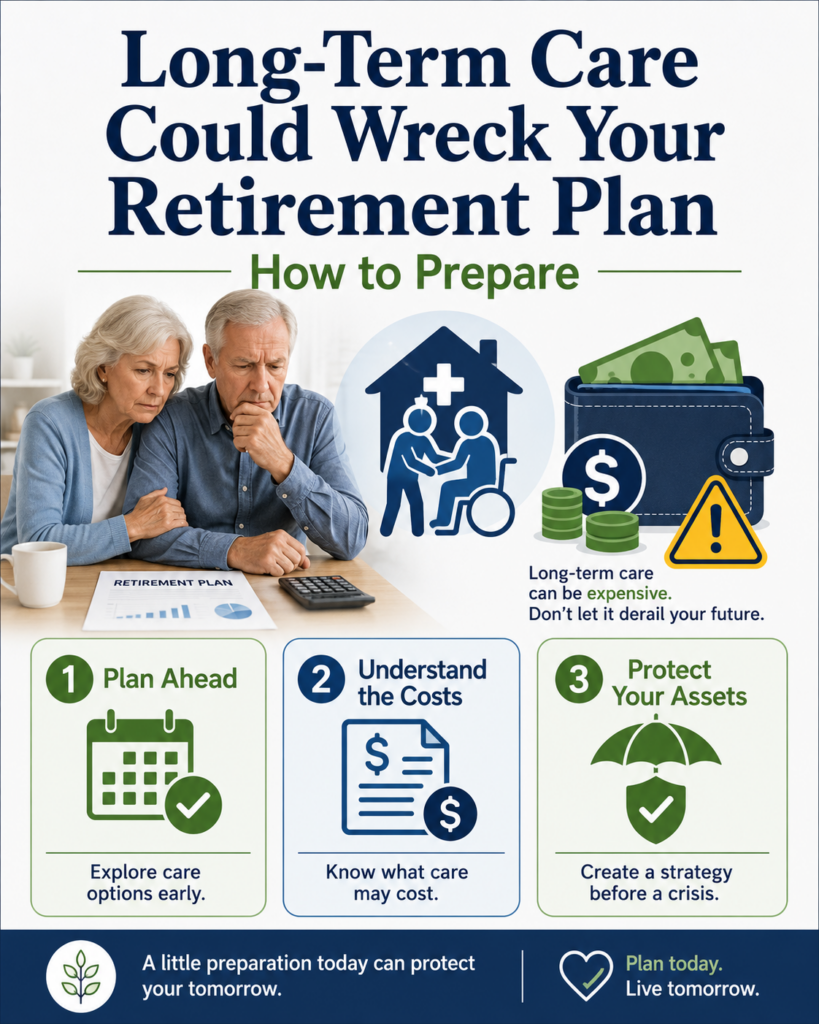
Long-Term Care Could Wreck Your Retirement Plan — Here’s How to Prepare
Most people think about retirement income, Social Security, taxes, investments, and market risk. But one of the biggest threats to a retirement plan is something many families don’t talk about until it’s already happening: long-term care.
Long-term care can mean help with bathing, dressing, eating, getting around, memory care, assisted living, home care, or nursing home care. It may happen because of aging, illness, injury, dementia, stroke, Parkinson’s, or simply needing help with daily life.
The financial problem is simple: long-term care can be expensive, it can last longer than expected, and Medicare generally does not cover ongoing custodial long-term care. Someone turning 65 today has nearly a 70% chance of needing some type of long-term care services during their lifetime.
In this article, we’ll walk through five ways to prepare so long-term care doesn’t wreck an otherwise solid retirement plan.
Key Point / Summary
Long-term care planning is about protecting income, assets, the healthy spouse, and your family from a care event that could last months or years.
Here are the five key things we’ll cover:
- Understand what long-term care actually means.
- Don’t assume Medicare will cover the problem.
- Know how expensive care can become.
- Decide how you would pay for care.
- Build long-term care into your retirement plan before there’s a crisis.
Recent long-term care cost surveys have reported national median annual costs around $70,800 for assisted living and more than $127,000 for a private nursing home room.
If you’re within a few years of retirement, a Retirement Readiness Review can help test how a long-term care event could affect your income, spouse, taxes, investments, and retirement security.
How Could Long-Term Care Wreck Your Retirement Plan?
Long-term care can wreck a retirement plan because it often creates a large expense at the worst possible time.
You may have a retirement plan that works beautifully if both spouses stay reasonably healthy. But what happens if one spouse needs $6,000, $8,000, $10,000, or more per month for care?
That can change everything.
It can affect:
- Investment withdrawals
- Cash reserves
- Taxes
- Roth conversion plans
- Social Security timing
- Housing decisions
- Spouse income security
- Estate planning
- Legacy goals
- Emotional stress on the family
The goal is not to predict exactly what will happen.
The goal is to decide ahead of time how you would handle care if it happens.
1. Understand What Long-Term Care Actually Means

The first step is understanding what long-term care actually is.
Long-term care is not always nursing home care.
That’s one of the biggest misconceptions.
Many people hear “long-term care” and immediately picture a nursing home. But long-term care can happen in several different settings.
It may include:
- Care at home
- Adult day care
- Assisted living
- Memory care
- Skilled nursing facility care
- Nursing home care
- Hospice support
- Help from family members
- Paid caregivers
- Help with daily activities
Long-term care usually becomes necessary when someone needs help with basic activities of daily living.
These may include:
- Bathing
- Dressing
- Eating
- Toileting
- Transferring from bed to chair
- Continence
- Walking or moving safely
It may also involve cognitive issues.
A person with dementia may be physically strong but unable to safely live alone, manage medications, cook, drive, or handle finances.
That type of care can be exhausting for a spouse or adult child.
The emotional burden matters too.
Long-term care is not just a financial issue. It’s a family issue.
A spouse may become the caregiver. Adult children may have to rearrange work, travel, finances, and family responsibilities. One child may do most of the work while others disagree from a distance. Money decisions can become emotionally charged.
That’s why the plan should not only ask, “How will we pay for care?”
It should also ask:
- Who would provide care?
- Where would we want care?
- Would we prefer to stay at home?
- What if home care is not enough?
- What role would adult children play?
- How much care could a spouse realistically provide?
- What if the caregiver spouse gets exhausted?
- What if memory care is needed?
- Who has legal authority to make decisions?
This is where honest conversations matter.
Most people say, “I don’t want to be a burden.”
That’s understandable.
But not wanting to be a burden is not a plan.
A better approach is to make decisions ahead of time so your spouse and children are not left guessing during a crisis.
A Retirement Readiness Review can help identify how a long-term care event could affect your income, assets, spouse, and family.
- Long-term care is not just nursing home care.
- Care can happen at home, in assisted living, or in a facility.
- Cognitive decline can create major care needs.
- Family caregiving has emotional and financial costs.
- A real plan should address money, location, caregivers, and decision-making.
2. Don’t Assume Medicare Will Cover the Problem

The second step is understanding what Medicare does and does not cover.
This is where many retirees get surprised.
Medicare is health insurance. It can help pay for doctor visits, hospital care, certain skilled nursing care, prescriptions, and other medical services depending on your coverage.
But Medicare generally does not pay for ongoing custodial long-term care.
Custodial care means help with daily living activities, such as bathing, dressing, eating, toileting, and personal care. Medicare may cover limited skilled care under specific conditions, but that is very different from paying for years of assisted living, memory care, or custodial nursing home care.
This distinction matters.
A person may need help every day but not need skilled medical care every day. That kind of ongoing help is often the expensive part families must figure out how to pay for.
This is where the retirement plan can break.
A couple may assume, “We have Medicare, so healthcare is handled.”
But long-term care is not regular healthcare.
Medicare is not designed to cover years of custodial care.
Medicaid may cover long-term care for people who qualify, but Medicaid has income and asset rules. It is not simply a backup plan for everyone with assets. Planning around Medicaid can also be complex and should involve qualified legal guidance.
That means many retirees may need to rely on some combination of:
- Personal savings
- Investment accounts
- Retirement account withdrawals
- Home equity
- Long-term care insurance
- Hybrid life/long-term care policies
- Annuity-based care features
- Family support
- Medicaid planning if appropriate
- Veterans benefits if eligible
- Reducing other spending
The mistake is waiting until care is needed.
At that point, options may be limited. Insurance may no longer be available or affordable. The healthier spouse may be overwhelmed. The family may be forced into rushed decisions.
Before retirement, you should ask:
- What care would Medicare actually cover?
- What care would we have to pay for ourselves?
- Would we qualify for any veterans benefits?
- Would Medicaid ever be part of the plan?
- Do we want to self-insure?
- Should we consider long-term care insurance?
- Should we consider hybrid coverage?
- How would care affect the healthy spouse?
A Retirement Readiness Review can help include long-term care as part of the retirement plan instead of treating it as a separate issue.
- Medicare generally does not cover ongoing custodial long-term care.
- Skilled care and custodial care are different.
- Medicaid may help, but only if eligibility rules are met.
- Waiting until care is needed can limit your options.
- Long-term care should be planned before retirement, not during crisis.
3. Know How Expensive Care Can Become

The third step is understanding the potential cost.
Long-term care can become expensive quickly.
Recent national median cost estimates show assisted living can cost around $70,800 per year, and a private nursing home room can cost more than $127,000 per year. Home health aide care can also cost tens of thousands of dollars per year.
Those numbers are national medians. Your actual cost may be higher or lower depending on your state, city, level of care, facility, and whether care is needed at home or in a facility.
But even rough numbers show why planning matters.
A three-year care event could potentially cost:
- $180,000 at $5,000 per month
- $288,000 at $8,000 per month
- $360,000 at $10,000 per month
- $432,000 at $12,000 per month
And that may not include inflation.
The cost is only part of the problem.
The timing matters too.
Long-term care often happens later in retirement, when:
- One spouse may already be gone.
- Investment accounts may be smaller.
- Required minimum distributions may be in effect.
- Healthcare costs may already be higher.
- The surviving spouse may be filing as single.
- Family caregivers may be older themselves.
A long-term care event can also create tax problems.
If you need to withdraw large amounts from a traditional IRA or 401(k) to pay for care, those withdrawals may increase taxable income. That could affect tax brackets, Social Security taxation, Medicare IRMAA premiums, and future investment sustainability.
For example, needing $100,000 for care may require more than $100,000 of withdrawals from a pre-tax account once taxes are considered.
That can create a painful cycle.
Care costs increase. Withdrawals increase. Taxes increase. More withdrawals are needed. The portfolio declines faster.
This is why long-term care is not just a healthcare problem. It is a retirement income problem.
You should test:
- One year of care
- Three years of care
- Five years of care
- Care for one spouse
- Care for both spouses
- Home care
- Assisted living
- Nursing home care
- Memory care
- Inflation-adjusted care costs
- Taxable account withdrawals
- IRA withdrawals
- Impact on the healthy spouse
A Retirement Readiness Review can help stress-test your retirement plan against possible care costs.
- Long-term care costs can be large.
- Costs vary by location and type of care.
- A multi-year care event can drain retirement assets.
- IRA withdrawals for care may create tax consequences.
- Care costs should be stress-tested before retirement.
4. Decide How You Would Pay for Care

The fourth step is deciding how you would pay for care.
There is no perfect answer.
Each strategy has trade-offs.
The main options usually include:
- Self-insuring with personal assets
- Traditional long-term care insurance
- Hybrid life insurance with long-term care benefits
- Annuity contracts with long-term care features
- Home equity
- Medicaid planning
- Veterans benefits
- Family support
- Some combination of the above
Self-insuring means you plan to pay for care from your own savings and income.
This may make sense for people with substantial assets. But it can be risky for people whose retirement plan barely works without a care event.
The question is not simply, “Can we pay for care?”
The better question is:
Can we pay for care and still protect the healthy spouse?
That is the key.
If one spouse needs care, the other spouse still needs income, housing, food, transportation, healthcare, and a life. You do not want the care event to financially destroy the person who remains healthy.
Traditional long-term care insurance may help cover care costs, but premiums can be expensive and may increase over time. You also need to qualify based on health.
Hybrid policies combine life insurance or annuities with long-term care benefits. These may appeal to people who dislike the “use it or lose it” nature of traditional long-term care insurance, but they also have costs, complexity, and trade-offs.
Home equity may be part of the plan, especially if downsizing, selling the home, or using other housing strategies becomes necessary. But relying on the home can be emotionally difficult and may not help if one spouse still needs to live there.
Medicaid may become part of the plan for some families, but it should not be casually assumed. Medicaid rules are complex, state-specific, and often involve income and asset limits.
Family care may help, but it is not free.
Even unpaid family care can create hidden costs:
- Lost wages
- Reduced retirement savings
- Emotional stress
- Travel costs
- Burnout
- Family conflict
- Health problems for the caregiver
This is why you should think through your preferred funding strategy before care is needed.
Ask:
- Are we planning to self-insure?
- If so, which assets would we use first?
- Would we consider long-term care insurance?
- Do we want traditional or hybrid coverage?
- Would we use home equity?
- Would we move closer to children?
- Would we want care at home if possible?
- What care costs could our plan absorb?
- What would protect the healthy spouse?
- Who would have legal authority to make decisions?
A Retirement Readiness Review can help compare long-term care funding strategies and show how each one affects the overall retirement plan.
- There is no perfect long-term care funding strategy.
- Self-insuring can work, but only if assets are sufficient.
- Insurance may help, but cost and health qualification matter.
- Home equity and Medicaid planning have trade-offs.
- The healthy spouse must be protected.
5. Build Long-Term Care Into Your Retirement Plan Before There’s a Crisis
[Image]
The fifth and most important step is building long-term care into the retirement plan before there’s a crisis.
This is where most people fall short.
They know long-term care is a risk, but they don’t make a decision. They say, “We’ll deal with it later.”
Later is usually when options are worse.
A strong retirement plan should include a long-term care stress test.
That stress test should answer:
- What happens if one spouse needs care for three years?
- What happens if care costs $8,000 per month?
- What happens if care costs inflate over time?
- What happens if the healthy spouse lives 15 more years?
- What assets would be used first?
- What income would continue?
- What taxes would be triggered?
- What happens to the home?
- Would the spouse still be financially secure?
- Would children need to help?
- Would insurance improve the plan?
- Would Medicaid planning ever be relevant?
- Are legal documents in place?
This is not about fear.
It is about control.
When you plan ahead, you can make decisions calmly. You can compare options. You can talk to your spouse. You can involve children if appropriate. You can review insurance while you may still qualify. You can update legal documents. You can organize accounts.
When you wait until a crisis, decisions are rushed.
Someone may already be in the hospital. A spouse may be overwhelmed. Adult children may disagree. Care facilities may have waiting lists. Insurance may no longer be available. Legal documents may be missing.
That is not the time to build the plan.
The best long-term care plan should include:
- A funding strategy
- A care preference
- A spouse protection plan
- Legal documents
- Updated beneficiaries
- Account access
- Trusted contacts
- Insurance review
- Tax planning
- Family communication
- A written roadmap
It does not have to be perfect.
But it does need to exist.
A Retirement Readiness Review can help test long-term care scenarios and create a practical plan before your family is forced to make decisions under pressure.
- Long-term care should be tested before retirement.
- Waiting until crisis limits options.
- The plan should protect the healthy spouse.
- Legal documents and account access matter.
- A written roadmap can reduce family stress.
Conclusion
Long-term care can wreck a retirement plan if it is ignored.
It can create large expenses, force bigger withdrawals, increase taxes, drain assets, stress the healthy spouse, and pull adult children into difficult decisions.
But long-term care does not have to be a mystery.
You can prepare.
Start by understanding what long-term care actually means. Don’t assume Medicare will cover everything. Know what care could cost. Decide how you would pay for it. Then test the impact inside your full retirement plan.
The goal is not to live in fear.
The goal is to protect the retirement you worked hard to build.
If you’re within a few years of retirement, a Retirement Readiness Review can help you test how long-term care could affect your income, investments, taxes, spouse, and legacy goals.
You don’t have to move your money. You don’t have to buy a product. You just need clarity before a care event forces decisions on your family.
FAQs
Does Medicare pay for long-term care?
Medicare may cover limited skilled care under certain conditions, but it generally does not cover ongoing custodial long-term care, such as help with bathing, dressing, eating, and daily personal care.
How much does long-term care cost?
Costs vary by location and type of care. Recent national median cost estimates show assisted living can cost around $70,800 per year, and a private nursing home room can cost more than $127,000 per year.
What is the best way to prepare for long-term care?
The best approach is to test the risk before there’s a crisis. Review whether you’ll self-insure, buy long-term care insurance, consider hybrid coverage, use home equity, or rely on other resources. The plan should protect both the person needing care and the healthy spouse.