
What Is an Annuity? The Simple Explanation Most People Need
Annuities can sound complicated, mostly because people talk about them in complicated ways. You’ll hear phrases like fixed annuity, indexed annuity, variable annuity, income rider, surrender charge, participation rate, payout option, annuitization, and lifetime income.
No wonder people get confused.
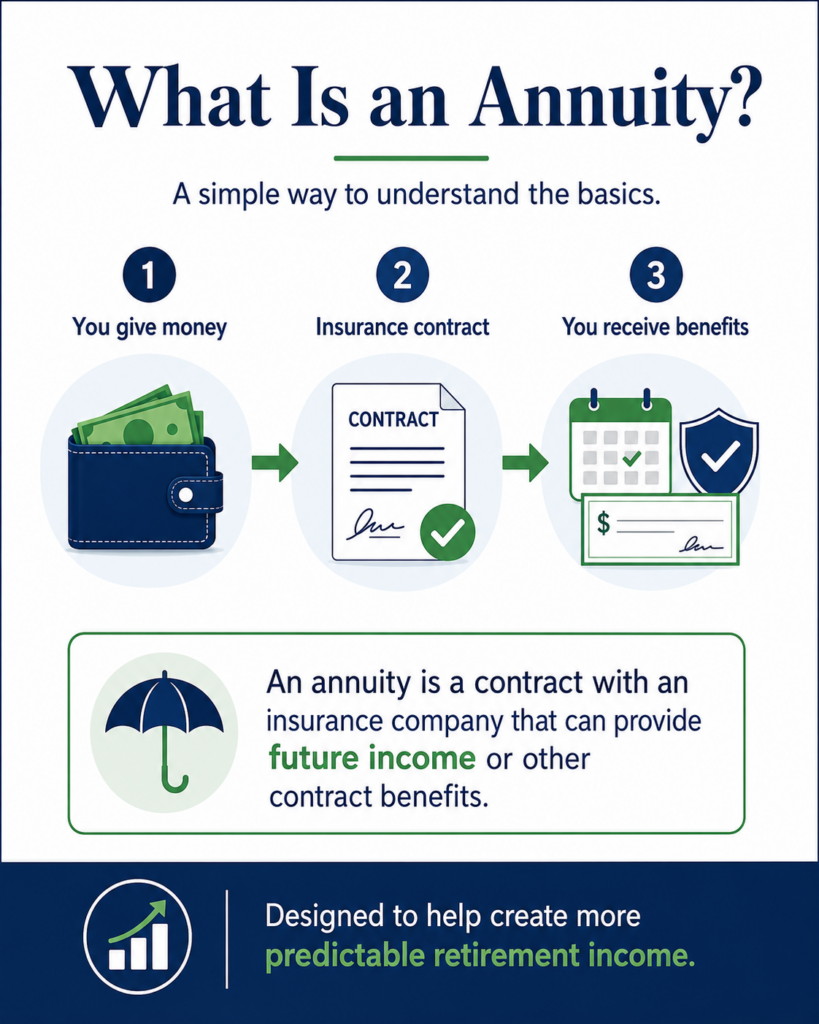
But at the simplest level, an annuity is a contract with an insurance company. You give the insurance company money, either all at once or over time, and in return the insurance company provides certain benefits. Those benefits may include growth, principal protection, tax deferral, death benefits, or income payments now or in the future.
In this article, we’ll break down what an annuity is, how it works, the different types, the benefits, the risks, and how to decide whether one belongs in your retirement plan.
Short on time? Here is a quick summary:
An annuity is a financial contract with an insurance company. It can be used to grow money, protect money, create income, or provide lifetime payments, depending on the type of annuity and the contract terms.
Here are the five key things we’ll cover:
- An annuity is a contract, not a magic investment.
- Different annuities do different jobs.
- Annuities can create income you can’t outlive.
- Annuities have trade-offs, including fees, surrender charges, and liquidity limits.
- The right annuity depends on your retirement plan, not a sales pitch.
If you’re within a few years of retirement, a Retirement Readiness Review can help you decide whether an annuity solves a real retirement problem or simply adds complexity you don’t need.
What Is an Annuity?
Again, an annuity is a contract between you and an insurance company.
You provide money to the insurance company. In return, the company agrees to provide benefits based on the contract. Those benefits might include a guaranteed interest rate, market-linked growth potential, lifetime income, death benefits, or other features.
The simplest way to think about an annuity is this:
An annuity is a tool designed to transfer certain risks from you to an insurance company.
Those risks may include:
- Outliving your money
- Losing principal in the market
- Not having predictable income
- Leaving a surviving spouse without enough income
- Creating tax-deferred growth
- Turning savings into a retirement paycheck
But here’s the key: annuities don’t eliminate every risk.
They usually trade one risk for another.
For example, an annuity may reduce market risk, but it may create liquidity risk. It may provide lifetime income, but it may reduce access to principal. It may offer principal protection, but it may limit upside growth.
That’s why the question should never be, “Are annuities good or bad?”
The better question is:
What job is this annuity supposed to do in my retirement plan?
1. An Annuity Is a Contract, Not a Magic Investment
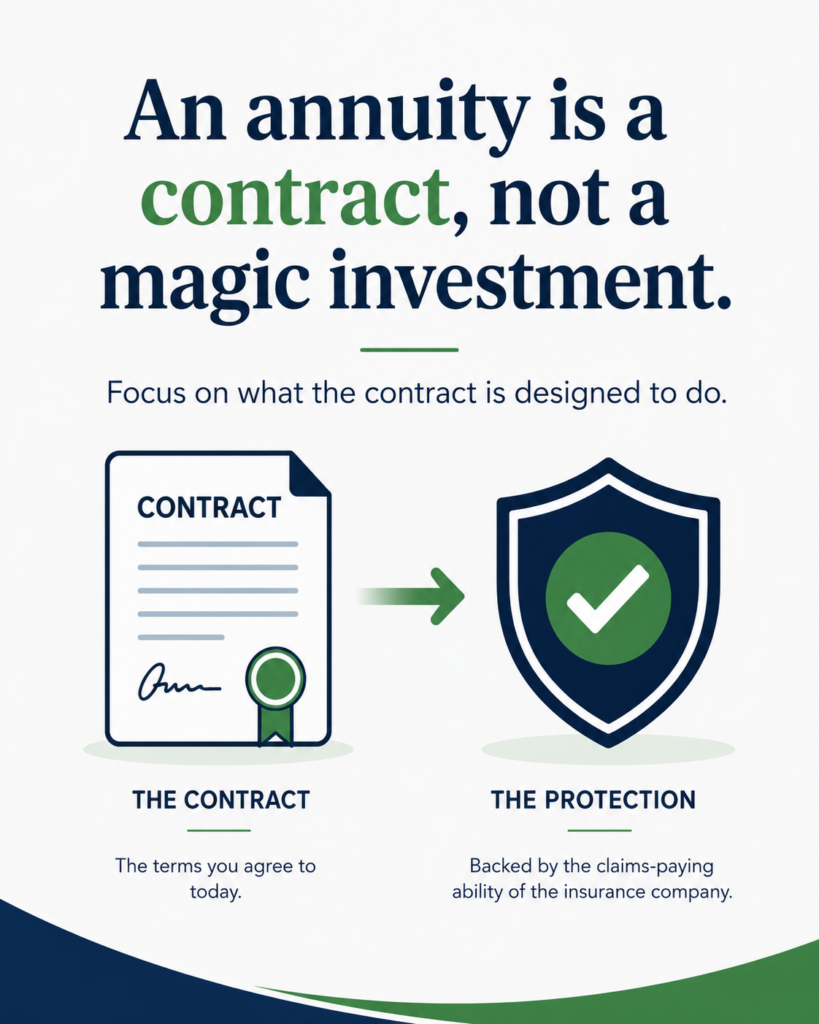
The first thing to understand is that an annuity is a contract.
That matters because the details are in the contract.
Some people talk about annuities like they’re all the same. They’re not. One annuity may be designed for safe growth. Another may be designed for lifetime income. Another may be tied to investments. Another may be linked to a market index but not directly invested in the market.
Because an annuity is a contract, the rules matter.
The contract explains:
- How your money grows
- When income can begin
- Whether income is guaranteed
- What fees apply
- How withdrawals work
- Whether surrender charges apply
- What happens if you die
- What happens if your spouse survives you
- Whether the income increases
- What values are guaranteed
- What values are only projected
This is where retirees can get into trouble.
They may hear one attractive feature and assume the whole product works exactly the way they want.
For example, someone may hear:
- “You can’t lose money.”
- “You get lifetime income.”
- “You get market upside.”
- “There are no fees.”
- “You get a bonus.”
- “You can access your money.”
Each statement may be partly true under certain contract rules. But none of those statements tells the whole story by itself.
For example, an annuity might protect principal from market losses, but still have surrender charges if you withdraw too much too soon. It might provide lifetime income, but that income may not increase with inflation. It might have no annual fee on the base contract, but still limit growth through caps, spreads, or participation rates.
The point is not that annuities are bad.
The point is that you need to understand what you’re signing.
Before buying an annuity, you should be able to answer:
- What type of annuity is this?
- What problem is it solving?
- What is guaranteed?
- What is not guaranteed?
- How do I access my money?
- What are the surrender charges?
- What are the fees or trade-offs?
- How does the insurance company make money?
- What happens if I die early?
- What happens if I live a long time?
- How does this affect my spouse?
If you can’t answer those questions, slow down.
A Retirement Readiness Review can help translate an annuity proposal into plain English before you commit to a contract.
- An annuity is a contract with specific rules.
- Not all annuities work the same way.
- Guarantees depend on the contract and the insurance company.
- One attractive feature does not explain the whole product.
- You should understand the annuity before buying it.
2. Different Annuities Do Different Jobs

The second thing to understand is that there are different types of annuities.
This is one reason the topic gets confusing. Saying “annuity” is like saying “vehicle.” A truck, car, minivan, and motorcycle are all vehicles, but they do different jobs.
Annuities work the same way.
Common types include:
- Fixed annuities
- Fixed indexed annuities
- Variable annuities
- Immediate annuities
- Deferred income annuities
- Registered index-linked annuities
A fixed annuity may provide a stated interest rate or minimum guaranteed rate. This may appeal to someone who wants principal protection and predictable growth.
A fixed indexed annuity credits interest based partly on the performance of a market index, subject to contract rules. You’re typically not directly invested in the index. The upside may be limited by caps, participation rates, spreads, or other formulas.
A variable annuity allows money to be allocated to investment subaccounts. This means the value can rise or fall based on investment performance.
An immediate annuity is designed to begin income soon after purchase. You give the insurance company a lump sum, and the company pays income based on the contract.
A deferred income annuity is designed to provide income later. This can be used to create income at a future age, such as 75, 80, or 85.
A registered index-linked annuity, often called a RILA, links returns to an index while also exposing the owner to some downside risk, depending on the contract structure.
Each type of annuity should be judged by the job it’s supposed to do.
For example:
- Want principal protection? A fixed or fixed indexed annuity may be considered.
- Want lifetime income? An immediate annuity, deferred income annuity, or income rider may be considered.
- Want investment growth with insurance features? A variable annuity may be considered.
- Want market-linked growth with some protection? A fixed indexed annuity or RILA may be considered.
- Want full liquidity? Many annuities may not be the best fit.
That last point is important.
Annuities are not designed to be all things to all people.
They’re tools.
The wrong tool for the wrong job can create frustration.
A Retirement Readiness Review can help determine whether any annuity type fits your actual retirement income need.
3. Annuities Can Create Income You Can’t Outlive

The third thing to understand is why many retirees consider annuities in the first place.
The big reason is income.
When you retire, you stop receiving a paycheck from work. That means your income must come from somewhere else.
Common retirement income sources include:
- Social Security
- Pensions
- Investment withdrawals
- Cash reserves
- Rental income
- Part-time work
- Annuities
For many retirees, the concern is not just, “How much money do I have?”
The deeper concern is:
Can I turn this money into reliable income for the rest of my life?
That’s where annuities may help.
Certain annuities can provide income for life. Some can provide income for one person. Others can provide income for two lives, such as a husband and wife. Some can provide income for a set period. Some can include refund or period-certain features.
This can be valuable because one of the biggest retirement risks is longevity risk.
Longevity risk is the risk of living longer than expected and needing income for more years than planned.
Living a long life is a blessing, but financially it means your savings may need to last 25, 30, or even 35 years.
An annuity may help transfer some of that longevity risk to an insurance company.
For example, suppose your essential expenses are $7,000 per month, and Social Security covers $4,800. That leaves a $2,200 monthly gap for basic expenses.
You could cover that gap with investment withdrawals. Or you could use part of your savings to create additional predictable income through an annuity.
That may reduce pressure on your investment portfolio.
It may also reduce emotional stress.
If basic expenses are covered by Social Security, pensions, and annuity income, you may feel less pressure to sell investments during a market downturn. Your portfolio can then be used more for inflation protection, lifestyle spending, emergencies, and legacy goals.
But lifetime income has trade-offs.
Depending on the annuity, you may give up some liquidity, control, upside, or legacy value in exchange for predictable income.
That’s why the income decision needs to be tested.
Questions to ask:
- How much guaranteed income do I already have?
- How much do I need for essential expenses?
- Would an annuity fill a real income gap?
- Should the income cover one life or two?
- Does the income increase with inflation?
- What happens if I die early?
- What happens if my spouse outlives me?
- How much liquidity would I lose?
- Would investment withdrawals work better?
Annuities can be powerful when they solve a real income problem.
They can be frustrating when they’re bought without a clear purpose.
A Retirement Readiness Review can help compare annuity income against investment withdrawals, Social Security timing, and other strategies.
- Some annuities can provide lifetime income.
- Lifetime income may reduce longevity risk.
- Annuities can help cover essential expense gaps.
- Income guarantees often come with trade-offs.
- The income strategy should be tested before buying.
4. Annuities Have Trade-Offs, Including Fees, Surrender Charges, and Liquidity Limits
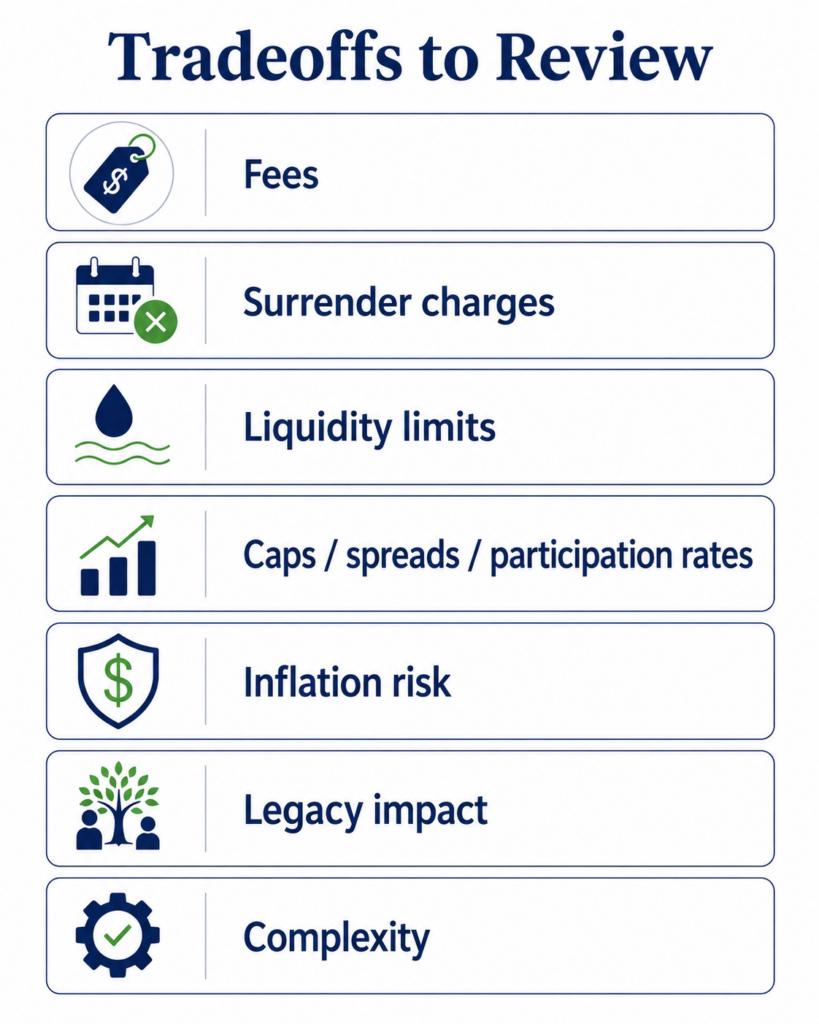
The fourth thing to understand is that annuities have trade-offs.
This is where people need to be careful.
Annuities are often sold by emphasizing the benefits:
- Principal protection
- Lifetime income
- Market-linked growth
- Tax deferral
- Death benefits
- Bonuses
- Guarantees
Those benefits may be real, but they are not free.
The trade-offs may include:
- Surrender charges
- Withdrawal limits
- Fees
- Rider charges
- Caps on growth
- Spreads
- Participation rates
- Market value adjustments
- Tax consequences
- Lower liquidity
- Complexity
- Inflation risk
- Reduced legacy value
A surrender charge is a fee you may pay if you withdraw too much money or cancel the contract during the surrender period. Surrender periods can last for several years, and surrender charges can reduce the value and return of the investment.
This matters because retirement is unpredictable.
You may need money for:
- Healthcare
- Long-term care
- Home repairs
- Taxes
- Family emergencies
- Travel
- A vehicle
- Moving or downsizing
- Market downturn protection
If too much of your money is locked into an annuity, you may not have enough flexibility.
Fees can also matter.
Variable annuities may include mortality and expense charges, administrative fees, investment subaccount expenses, surrender charges, and rider fees.
Fixed indexed annuities may not always show fees the same way. Some may have no direct annual fee on the base contract, but the trade-offs may show up through caps, spreads, participation rates, or crediting limits.
Again, this does not mean annuities are bad.
It means you must understand the trade.
A fair annuity conversation should include both sides:
- What benefit do I receive?
- What do I give up?
- What does it cost?
- How do I access money?
- What happens if I change my mind?
- What happens in a bad scenario?
- What other options should I compare?
Be careful if the conversation only focuses on the good parts.
A Retirement Readiness Review can help compare the annuity’s benefits against its costs, restrictions, and alternatives.
5. The Right Annuity Depends on Your Retirement Plan, Not a Sales Pitch

The fifth and most important point is this:
An annuity should not be purchased because of a sales pitch.
It should be purchased only if it solves a specific retirement planning problem.
That problem might be:
- Not enough guaranteed income
- Fear of outliving money
- Too much pressure on investment withdrawals
- Need for spouse income protection
- Desire for principal protection
- Concern about sequence-of-returns risk
- Need for a private pension-like income stream
But an annuity may not be appropriate if:
- You need full access to your money
- You already have enough guaranteed income
- You don’t understand the contract
- The surrender period is too long
- The fees are too high
- The product is too complex
- You’re being pressured
- The annuity does not improve the plan
The right process should start with your retirement plan.
First, create a baseline.
What happens if you keep doing what you’re doing?
Then test options.
What happens if you delay Social Security? What happens if you use investment withdrawals? What happens if you use a cash reserve? What happens if you add an annuity? What happens if the market drops? What happens if one spouse dies? What happens if long-term care is needed?
That’s how you decide whether an annuity belongs in the plan.
The annuity should be compared against alternatives like:
- Investment withdrawals
- Treasury ladders
- CD ladders
- Bond ladders
- Delaying Social Security
- Pension options
- Cash reserves
- Roth conversions
- Spending adjustments
- Working part-time
The goal is not to be pro-annuity or anti-annuity.
The goal is to be pro-plan.
Some retirees may benefit from an annuity. Others may not need one. Some may benefit from using an annuity for part of their income need while keeping the rest of the portfolio invested for flexibility and growth.
A Retirement Readiness Review can help you test the annuity before you buy it.
Conclusion
An annuity is simply a contract with an insurance company.
But annuities are not all the same.
Some are designed for accumulation. Some are designed for income. Some protect principal. Some expose you to investment risk. Some provide lifetime payments. Some limit liquidity. Some are simple. Others are complex.
That’s why the simple explanation is this:
An annuity is a tool. It can be useful when it solves the right problem, but it can be costly or frustrating when it’s used for the wrong reason.
If you’re considering an annuity, don’t start with the product.
Start with your retirement plan.
How much income do you need? What does Social Security cover? Do you have a pension? How much risk can your investments handle? What happens if the market drops? What happens if one spouse dies? How much liquidity do you need?
Once those questions are answered, then you can decide whether an annuity fits.
If you’re within a few years of retirement, a Retirement Readiness Review can help you compare annuities, investment withdrawals, Social Security timing, taxes, survivor income, and market risk so you can make a clearer decision.
You don’t have to move your money. You don’t have to buy a product. You just need clarity before signing a long-term contract.
FAQs
What is an annuity in simple terms?
An annuity is a contract with an insurance company. You give the company money, and in return the company provides certain benefits, such as growth, principal protection, income payments, or lifetime income, depending on the contract.
Are annuities good or bad?
Annuities are not automatically good or bad. They are tools. An annuity may be helpful if it solves a real retirement problem, such as lifetime income or principal protection. It may be a poor fit if you need liquidity, don’t understand the contract, or are buying it because of pressure.
Can you lose money in an annuity?
It depends on the type of annuity. Some fixed annuities may protect principal under the contract terms. Variable annuities can lose value because they are tied to investment performance. Even with principal protection, surrender charges, fees, taxes, and inflation can still affect your outcome.